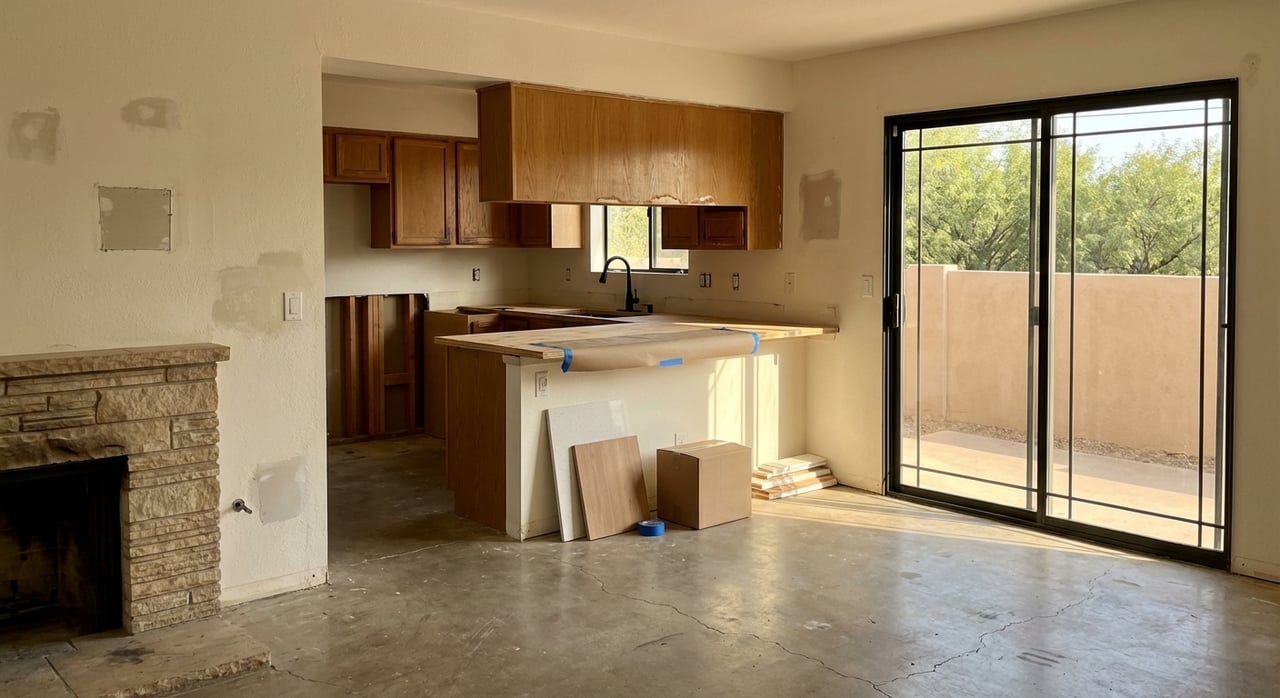
Is now the right time to buy a Phoenix fixer-upper? With more listings sitting longer and sellers more open to concessions, the answer could be yes if you know how to separate a smart project from a money pit. You want a clear, local process you can trust so you avoid hidden issues, budget with confidence, and hit your target return. In this guide, you’ll learn a step-by-step framework to evaluate any Phoenix property using public records, permit checks, comps, rent data, and simple formulas. Let’s dive in.
Phoenix market: opportunity with due diligence
Phoenix’s market cooled from the pandemic peak, which means more inventory and longer days on market. That shift gives you more negotiation room than during the 2020 to 2022 frenzy, especially on homes that need work. Recent reporting on stale listings and price cuts backs this up.
At the same time, the region’s population and job base continue to support demand. Phoenix added an estimated 17,000 residents from 2023 to 2024, which helps rental demand in many submarkets, even as overall growth has cooled from the surge years. See the population growth snapshot for context.
Bottom line: you can often buy at a discount today, but micro-neighborhood selection and disciplined underwriting matter.
Start with public records
Before you tour, pull official property facts. The goal is to confirm ownership, taxes, size, year built, and nearby sales.
- Use the Maricopa County Assessor parcel search to find the APN, assessed value, improvement details, lot size, and prior transfers.
- Cross-check nearby parcels and sales context in the Maricopa County Property Search/GIS.
- Confirm the property’s tax and payment history in the Maricopa County Treasurer portal. Look for delinquencies or unusual jumps.
These tools give you reliable facts for comps and carrying cost estimates.
Verify permits and spot red flags
Unpermitted work can derail a deal or add major expense. Always check the City of Phoenix permit history.
- Search the address in the city’s SHAPE PHX permit portal to review past and current permits, inspections, and plan reviews.
- Confirm whether key permits closed properly (electrical panel upgrades, HVAC, roof, pool, additions). Open or expired permits are negotiation items.
- If you see work in the home that lacks a permit trail (new baths, converted garage, added square footage), budget for permit remediation and possible code upgrades.
Nail ARV with neighborhood comps
Your after-repair value (ARV) sets your ceiling for purchase price and scope. Build it from renovated comps in the same micro-area.
- Pull 3 to 5 closed sales of updated homes within about 0.5 to 1 mile and a similar market area. Match beds, baths, finished square footage, lot size, and amenities like pool or garage.
- Verify details in the Maricopa County parcel records to confirm MLS claims.
- Compute a price-per-square-foot range from those renovated comps, then multiply by your target finished square footage for a realistic ARV band.
Example formula: ARV target = Comp average price per sqft × Subject finished sqft. Adjust carefully for differences in beds/baths, lot size, pool, or ADU.
Build a scope and realistic budget
Prioritize repairs so you focus dollars where buyers and renters value them most.
- A: Must-fix safety/code items (electrical, plumbing, roof, HVAC, structural, permits)
- B: Marketable cosmetics (paint, floors, lighting), kitchen, baths, curb appeal
- C: Value-add extras (landscape upgrades, outdoor living, storage, smart-home features)
Use regional benchmarks as a gut check, then get 2 to 3 written bids from Phoenix contractors. The annual “Cost vs. Value” summaries help you weigh midrange costs and typical cost recovery. Review a current overview here: Remodeling Cost vs. Value insights.
Conservative 2024 to 2025 guidance from industry sources suggests:
- Cosmetic refreshes can land in the low tens of thousands.
- A midrange kitchen or bath grouping often runs low to mid $20k to $50k depending on scope and finishes.
- Full gut remodels or additions commonly exceed $50k.
Always add a 10 to 20 percent contingency for surprises, especially if the home is older or has permit uncertainty.
Account for Phoenix-specific realities
Phoenix homes and climate introduce unique project risks and costs you should plan for upfront.
- Pools: Many homes have them, which affects resale and rental potential. Expect ongoing maintenance and eventual resurfacing. Recent local guidance places resurfacing from low $5,000 to $15,000+ depending on finish, with annual maintenance often $1,000 to $4,000 or more. Get quotes early. See a practical cost overview on pool resurfacing and alternatives.
- HVAC and cooling: AC is mission-critical in Phoenix summers. Older, low-SEER systems often need replacement, which can cost several thousand dollars. Factor this into your must-fix list. For national renovation ROI context, review NAR remodeling resources.
- Monsoon season and roofs: Mid-June through September can bring heavy rains that expose drainage, flat-roof, and scupper issues. Inspect roofs and grading before you write your offer and budget for potential repairs.
- Expansive soils and foundations: Shrink-swell soils are common in Arizona and can cause settlement over time. If you see cracks or sticking doors, get a professional foundation evaluation. Read the Arizona Geological Survey’s guidance on problem soils.
- Unpermitted work: Use SHAPE PHX to verify permit status. Lenders and title may require retroactive permits or repairs.
- Floodplain checks: Confirm flood risk and any insurance needs using county and FEMA resources via Maricopa County Flood Control quick links.
Rent and hold math made simple
If you plan to hold, estimate rent and convert it to a cap rate.
- Pull 3 to 5 local rent comps by ZIP or neighborhood using a hyperlocal index like Rentometer’s Phoenix averages. Note: cite the date of the rents you use (for example, Rentometer Q1 2025).
- Estimate monthly NOI: NOI = Gross Rent × (1 − vacancy rate) − operating expenses (taxes, insurance, management, repairs, utilities you cover).
- Many Phoenix SFR investors underwrite with a 30 to 45 percent operating expense range as a quick estimate, then refine it with line-item quotes.
- Implied cap rate = Annual NOI ÷ Total acquisition cost (purchase + rehab + closing).
Compare your cap rate to your financing and risk tolerance, and to local market color. Recent multifamily trades in Phoenix ran in the mid 4 percent cap range in early 2025, reflecting strong demand, while single-family rental cap rates vary widely by neighborhood and rent level. For context, see multifamily market cap-rate reporting.
Quick flip screen and carrying costs
Use a conservative screen to see if a flip pencils before you spend on inspections and bids.
- 70 percent rule: Max Purchase Price = (ARV × 70%) − Repair Cost. Treat this as a quick filter, not a final decision tool. In slower segments you may aim below 70 percent; in faster micro-markets, investors sometimes adjust slightly.
- Add carrying costs: property taxes, insurance, HOA (if any), utilities, loan interest, and maintenance for your expected hold. Arizona’s overall effective property tax rate is relatively low compared with many states, but use the parcel’s actual history from the Maricopa Treasurer search for precision. For national context, see the Tax Foundation’s state burden data.
A 7-step Phoenix fixer-upper framework
Use this repeatable process to reduce surprises and increase your odds of profit.
- Paper triage (3 to 10 minutes)
- Check the Assessor and Treasurer for ownership, taxes, and red flags.
- Glance at neighborhood sales in the county GIS.
- Permit history (15 to 30 minutes)
- Search SHAPE PHX for permits and inspections.
- Note open, expired, or unfinaled permits as negotiation items.
- ARV comps (30 to 90 minutes)
- Choose 3 to 5 renovated sales within 0.5 to 1 mile that match beds, baths, size, lot, and amenities.
- Verify all details in county records and set a price-per-square-foot target for ARV.
- Scope and bids (1 to 3 days)
- Build A/B/C priorities and get 2 to 3 contractor bids. Cross-check with Cost vs. Value benchmarks.
- Add a 10 to 20 percent contingency.
- Rent and hold analysis
- Pull rent comps on Rentometer, compute NOI, and estimate cap rate.
- Flip screen
- Run the 70 percent rule and adjust for your risk and timeline.
- Final risk checks
- Confirm floodplain via Maricopa County Flood Control links, foundation indicators via AZGS guidance, and permit status via SHAPE PHX.
When to flip vs. hold
Choose the strategy that best fits the home and the submarket.
- Flip when: ARV supports a strong margin after selling and carrying costs, the repair timeline is short, and buyer demand for your finished product is deep.
- Hold when: Stabilized NOI delivers a cap rate that meets your target, and the micro-neighborhood shows healthy rent and appreciation drivers. Use local rent comps rather than a national rule of thumb.
Common pitfalls to avoid
- Skipping permit checks: Unpermitted additions or electrical work can become costly corrections.
- Underestimating HVAC or roof costs: Phoenix heat and monsoon season push systems hard.
- Ignoring pools: Resurfacing and ongoing service can change your ROI if you do not budget for them.
- Overbuilding for the block: Match scope and finishes to nearby renovated comps.
- Thin contingencies: Old homes and unknowns deserve a 10 to 20 percent buffer.
Save this mini-checklist
- Confirm parcel facts and taxes in county portals.
- Verify permit history and closeout status in SHAPE PHX.
- Build ARV from 3 to 5 nearby renovated comps.
- Create A/B/C scope and collect 2 to 3 bids.
- Pull rent comps and compute NOI and cap rate if holding.
- Screen with the 70 percent rule if flipping.
- Check floodplain, soils, roof, HVAC, and pool costs.
If you want a second set of eyes on comps, permit history, or scope, we’re here to help. As a boutique Phoenix–Scottsdale practice backed by Keller Williams systems, we combine neighborhood expertise with media-grade marketing and fast, clear communication. Let’s pressure-test your numbers and find the right project for your goals. Connect with MCK Partners to get started.
FAQs
How do I check permits for a Phoenix fixer-upper?
- Search the address in the City of Phoenix SHAPE PHX portal to view permits, inspections, and whether permits closed properly; open or expired permits are negotiation items.
What is the best way to estimate ARV in Phoenix?
- Pull 3 to 5 closed sales of renovated homes in the same micro-area, verify details in the Maricopa County parcel records, compute a price-per-square-foot range, and multiply by your target finished square footage.
How can I estimate rent for a buy-and-hold in 2025?
- Use a local index like Rentometer’s Phoenix averages, then compute NOI and cap rate (NOI ÷ total acquisition cost) and document the date of the data you used (for example, Rentometer Q1 2025).
What Phoenix-specific repair costs should I plan for?
- Budget for HVAC replacement if systems are old, inspect roofs and drainage ahead of monsoon season, account for pool resurfacing and maintenance using local quotes, and add a 10 to 20 percent contingency; review Cost vs. Value insights as a benchmark.
What is the 70 percent rule and how do I use it?
- As a quick flip screen, estimate Max Purchase Price = (ARV × 70%) − Repair Cost, then adjust for Phoenix holding and selling costs and confirm with detailed comps and contractor bids before proceeding.
How do property taxes affect my flip or rental in Arizona?
- Arizona’s effective property tax burden is relatively low compared with many states (see the Tax Foundation), but always use the parcel’s actual bill from the Maricopa Treasurer search for accurate underwriting.